_edited_edited_p.png)
Can AI Fix Your Living Room Layout?
- Mar 17
- 3 min read
Updated: Apr 26
I keep seeing people ask AI to “fix” their living room.
I get it — it feels like the quick, easy (and cheap) fix. But can AI really solve the problem with your space?
I was curious, so I asked AI to generate a living room layout for an empty room drawn to scale.
Take a look at the results. What do you notice?

I see a layout that technically fits all the furniture.
But that doesn’t mean it works.
See how the two chairs and hallway table create such a narrow path? This is the main walkway of the house. Picture yourself living there — bumping and squeezing past with arms full of groceries (because who doesn’t try to get it all in one trip?).
Now imagine sitting in that chair with your knees bumping the side of the sofa.
Did you notice the entire wall and side of the room left completely unused?
Instead of using the full space, the furniture crowds the walkway while the rest of the room sits empty. The result is an unbalanced layout and creates unneccessary congestion.
Technically the furniture fits.
But the room doesn’t work.

What Good Layouts Actually Consider
When furniture is placed in a room, the space around the furniture matters just as much as the furniture itself.
Walkways need enough room for people to move through comfortably. Seating areas need breathing room so people can sit, stand, and shift naturally. And the room should feel balanced instead of crowded on one side and empty on the other.
When those pieces fall out of balance, the room starts working against the way people naturally move through it.
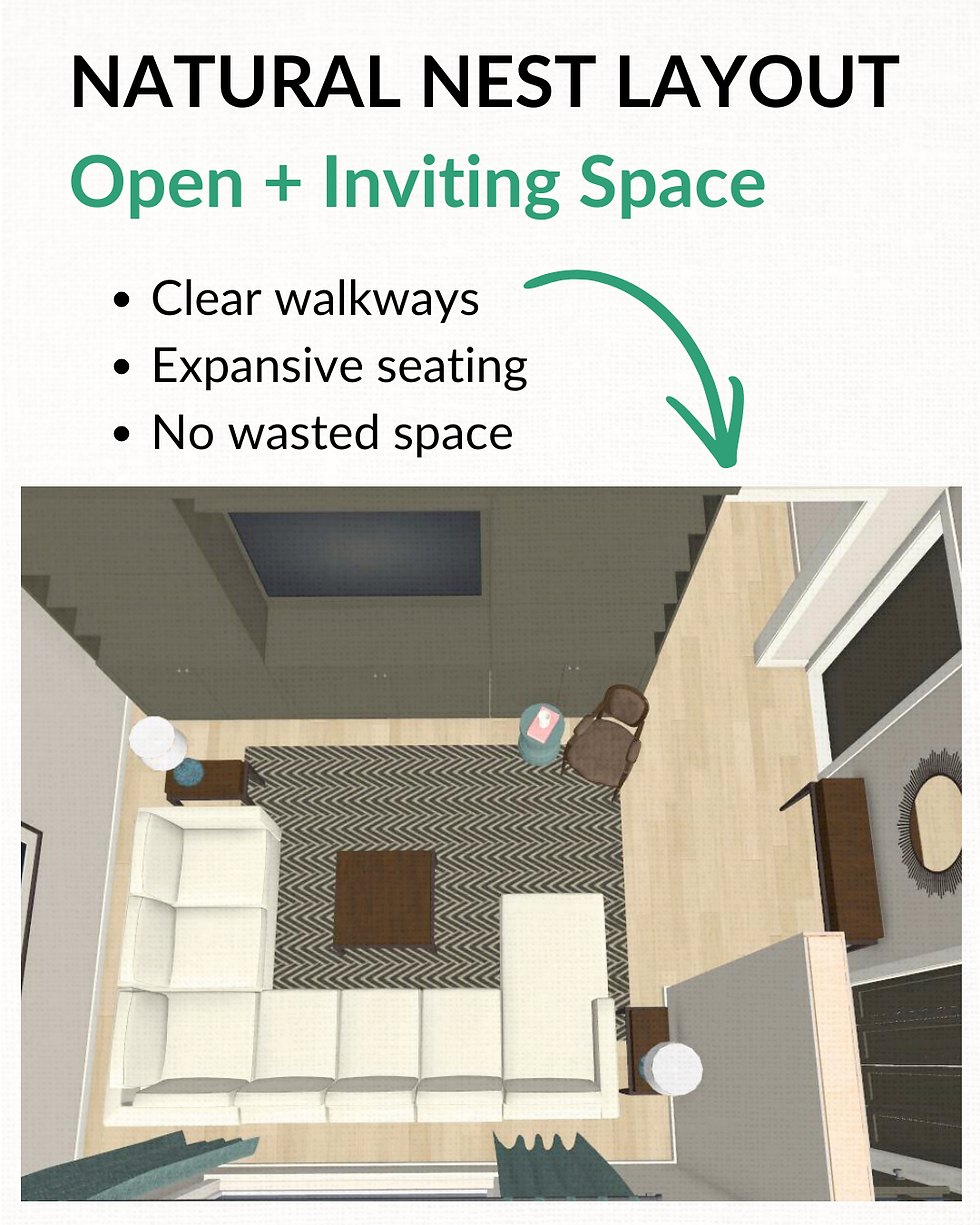
The Layout I Created Instead
When I reworked the layout, the goal wasn’t to remove furniture.
It was to use the room more intentionally.
Instead of leaving one side empty and crowding the entry walkway, the seating spreads across the space in a way that creates clearer paths through the room and a more balanced seating area.
Interestingly, the revised layout also seats more people while still feeling more open.
This is just one example of how much difference thoughtful furniture placement can make. There are actually multiple layouts that could work for this space.
3D generated view created by Natural Nest Interiors 3D view of layout created by Natural Nest Interiors
The “Cheap Fix” That Can Get Expensive
AI might seem like the quick and inexpensive solution.
But if someone starts buying furniture based on a layout that doesn’t actually work for their space, that “cheap fix” can become expensive quickly.
AI layouts also don’t help determine the right furniture sizes — whether a sofa should be 84 inches or 96, whether a sectional will block a walkway, or how much space seating really needs around it.
Those sizing decisions are often what make or break a layout, and they’re surprisingly easy to get wrong without seeing the room to scale first.
The Takeaway
AI can place furniture in a room.
But it doesn’t understand how a space actually functions — how people move through it, where things start to feel tight, or why a room can feel off even when everything technically fits.
A good layout comes from seeing the room as a whole.
It’s a combination of real-life understanding — how you live in the space — and the tools to map it out clearly so you can see what’s working and what’s not.
Because a room isn’t just about what fits.
It’s about how it feels and how it functions.
Want to talk about what’s not working in your space?
FAQ
Can AI design a living room layout?
AI tools can generate layout ideas quickly, but they often focus on fitting furniture into a room rather than evaluating how people move through and use the space.
Why is furniture spacing important in a living room layout?
Furniture needs breathing room. Tight seating areas and blocked walkways can make a room feel cramped and awkward even if everything technically fits.
How do you know if a living room layout works?
A good layout allows people to move naturally through the room, creates comfortable seating areas, and uses the space in a balanced way.


Comments