_edited_edited_p.png)
The 3 Things I Look for Right Away in Any Room
- Apr 25
- 6 min read
Updated: Apr 26
I don’t need a full walkthrough to know when a room isn’t working.
Give me a few photos, and I can usually tell pretty quickly where things are falling apart. Not because of the furniture, and not because of your style—but because the layout isn’t doing what it needs to do.
Most of the time, it comes back to the same few things.
Quick Take (Start Here)
If your room feels off, it usually comes down to one of three things (or a combination of all of them):
🪺 The walkways feel tight or awkward
🪺 Nothing is anchoring the space
🪺 The furniture isn’t actually working together
It’s not about buying all new furniture.
It’s about understanding what the room needs—and setting it up in a way that supports how you actually live in it.
1. Tight Walkways (When the Room Makes You Work to Move Through It)
This is almost always the first thing I notice, and it’s usually something people have gotten so used to that they don’t question it anymore.
Nothing is technically “blocking” you, but you’re constantly adjusting. You’re stepping around a chair, turning sideways near the sofa, or taking a longer path through the room without really thinking about it. It works… but it doesn’t feel easy.
That’s where I pay attention.
Because movement in a room should feel natural. You shouldn’t have to think about how you’re getting from one spot to another. When a layout is doing its job, your body just moves through the space without hesitation.
When it’s not, you feel it. Even if you’ve never said it out loud.
And that’s a layout problem—every time.

2. No Anchor (When Nothing Is Really Holding the Room Together)
This is the point where a room starts to feel a little unsettled, even if everything in it is technically “nice.”
You’ve got furniture, you’ve got decor, maybe even a rug… but nothing is really grounding the space. There isn’t a clear center, and your eye doesn’t have anywhere obvious to land.
This is where I start looking more closely at scale and connection.
Is the rug actually big enough to hold the seating area, or is everything kind of floating around it? Are the pieces relating to each other, or just sitting near each other?
When that foundation is off, everything starts to compete. That’s when a room begins to feel busy, even if there isn’t that much in it. Your eye keeps moving, trying to make sense of what it’s seeing.
An anchored room doesn’t just look better—it feels calmer. Like everything finally has a place to settle.

3. Disconnected Furniture (When Everything Exists but Nothing Works Together)
This is a big one, and it shows up in a lot of different ways.
You can have great furniture and still have a room that doesn’t work at all. Because the issue isn’t what you have—it’s how it’s arranged.
Pieces are too far apart, too close, or slightly off from each other. Chairs that should be part of a conversation area are drifting on their own. Furniture gets pushed to the walls because it feels like it “should,” even when that breaks the room.
And then there’s what happens when you walk into the space.
Where does your eye go first? Is there something that naturally leads the room, or does everything feel equal and a little scattered?
If everything is asking for your attention at the same time, nothing really stands out.
That’s not a decorating issue. That’s layout.

This Might Sound Familiar
If you’ve ever paid attention to your body, you already know how this works.
You can feel when something is off pretty quickly. Something feels tight, or you can’t quite settle, or you find yourself adjusting over and over without really thinking about it. And instead of forcing it, you shift. You give yourself a little more space. You find a position that actually feels stable so everything else can relax around it.
That same awareness shows up in your home, whether you realize it or not.
When a room isn’t working, you feel it in a similar way. Movement feels a little restricted. Nothing quite settles. Your eye keeps moving because it doesn’t have anywhere clear to land.
The space is missing something it needs—more room to move, something to ground it, or a layout that actually connects the pieces in a way that makes sense.
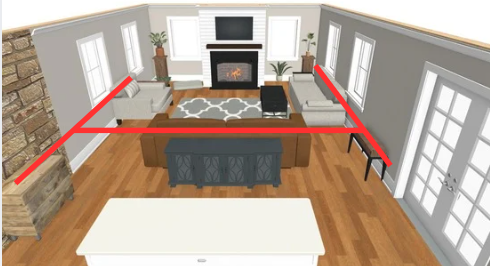
Here’s Where My Work Actually Comes In
This is the part people don’t always see.
It’s not about moving one thing and hoping it clicks. It’s about understanding why the room isn’t working and making changes that actually solve that problem.
When I’m working through a space, I’m not just shifting furniture around to see what looks better.
I’m looking at how the room functions as a whole. How you move through it. How it holds what’s in it. What your eye does when you walk in.
From there, I’m making very specific decisions—adjusting the flow, changing the scale where it’s off, creating a clear center, and connecting the pieces so the room actually works as one space instead of a collection of things.
Sometimes that means keeping what you already have and using it in a better way. Sometimes it means something needs to change.
But either way, it’s intentional. There’s a reason the final layout works, and you can feel that difference right away.
New conversational seating arrangement and open walkways New living room layout with connected seating and anchored rug
If Your Room Isn’t Working, There’s a Reason
Rooms don’t feel awkward for no reason.
They feel that way when the layout isn’t supporting the space—or the way you’re trying to live in it.
And it’s not something you fix by guessing or rearranging things over and over, hoping it finally clicks.
At some point, you have to step back and actually see what’s going on.
That’s where things start to shift.
A Simple Way to Look at Your Space Differently
If you’re standing in your room right now, don’t overthink it—just notice your first reaction.
🪺 Do you naturally move through the space, or are you constantly adjusting as you go?
🪺 Does the room feel calm, or does it feel a little busy or unsettled?
🪺 Do the pieces feel like they belong together, or like you’ve been trying to make them work for a while?
🪺 When you walk in, does anything stand out… or does everything kind of compete?
You don’t need to fix it all today.
But once you can see what’s actually happening, you can start making decisions that work.
If you want help seeing your space this clearly—without second guessing every move—
you can start with a clarity call.
We’ll look at what’s not working, talk through how you actually use the space, and figure out what kind of plan will actually fix it.
Common Questions
Do I need all new furniture to fix my layout?
No. Most of the time, the biggest shift comes from using what you already have in a better way. Sometimes a piece needs to change—but layout comes first.
Why does my room feel off even though everything “fits”?
Because fitting and functioning aren’t the same thing. A room can technically fit everything and still feel awkward if the layout isn’t supporting movement, balance, and connection.
How do I know if my layout is the problem?
If you’re constantly adjusting, second guessing, or rearranging things and it still doesn’t feel right—it’s usually the layout.
Is there only one “right” way to lay out a room?
No. There are usually a few good options. The goal is finding the one that works best for how you actually use the space.


Comments